
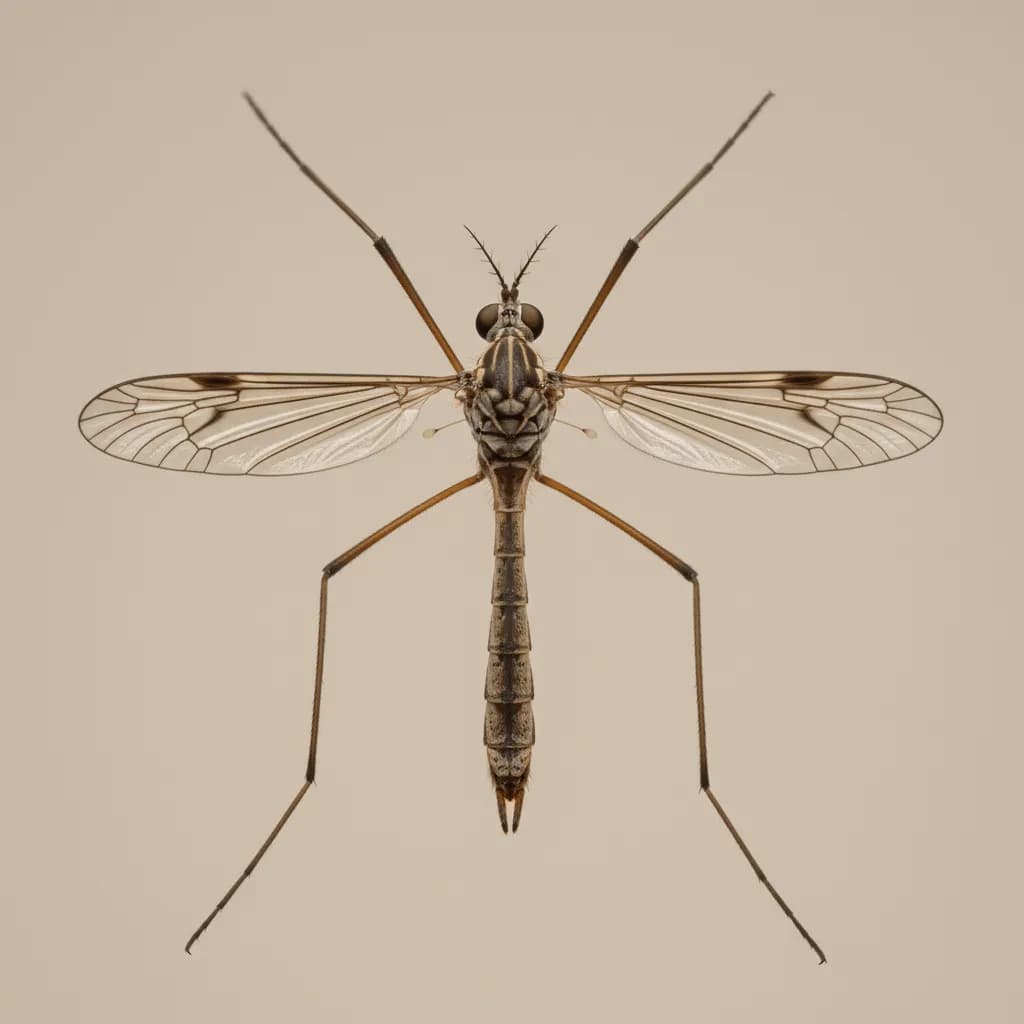
Crane Fly
Tipula oleracea
Also known as: Mosquito Hawk, Daddy Longlegs Fly, Leather Jacket
Crane flies are large, gangly flies commonly mistaken for giant mosquitoes. Despite the widespread myth that they are mosquito predators, adult crane flies do not eat mosquitoes and most species do not feed at all. Their larvae, called leatherjackets, live in soil and feed on grass roots, occasionally causing lawn damage. Adults are completely harmless.
Identification
Size
15-25 mm (body length); wingspan up to 75 mm
Color
Grayish-brown with very long, fragile legs and narrow translucent wings
Key Trait
Mosquito-like appearance but much larger; extremely long, fragile legs that detach easily; clumsy, bouncing flight pattern; does not bite or sting despite common misconception.
Behavior & Habitat
Attracted to lights in large numbers during emergence periods. Clumsy fliers with a bouncing, erratic flight pattern. Adults live only a few days focused on mating. Legs detach readily as a defense mechanism. Do not bite or feed as adults.
Habitat: Larvae live in moist soil, particularly in well-watered lawns, pastures, and turf. Adults are found near lights, on exterior walls, and in vegetation near turf areas.
Diet: Adults do not feed or consume only small amounts of nectar. Larvae (leatherjackets) feed on grass roots, decaying organic matter, and other soil organic material.
Signs of Infestation
- Large mosquito-like flies congregating around porch lights and exterior walls in spring or fall
- Brown patches in lawn caused by larval (leatherjacket) root feeding
- Birds such as starlings and crows pecking heavily at lawn areas, digging for leatherjacket larvae
Risks & Damage
Larvae (leatherjackets) feed on grass roots and can cause significant turf damage, particularly in well-watered lawns in the Pacific Northwest and northern regions.
Adults enter homes in large numbers when attracted to lights, causing alarm due to their mosquito-like appearance.
Prevention Tips
- 1.Reduce excessive lawn watering which creates ideal conditions for leatherjacket development
- 2.Maintain healthy, vigorous turf that can tolerate moderate larval feeding
- 3.Use yellow or sodium vapor exterior lighting to reduce attraction of adults
Why DIY Treatment Often Falls Short
The adults that enter homes are harmless and controlling them is unnecessary. Lawn damage from larvae requires proper timing and identification, and surface-applied products often fail to reach larvae in the soil.
Professional Treatment
For significant turf damage, professionals apply targeted larvicide treatments to the lawn in early fall when young larvae are actively feeding near the surface. Biological controls including beneficial nematodes can also be effective.
Related Pests
Frequently Asked Questions
Are crane flies giant mosquitoes?
Do crane flies eat mosquitoes?
Are they damaging my lawn?
Need Help With Crane fly?
If you're seeing signs of crane fly in or around your home, professional treatment is the fastest way to stop the problem. Lotus Pest Control offers free inspections to identify the issue and recommend the right solution.
At a Glance
- Category
- Flies
- Scientific Name
- Tipula oleracea
- Size
- 15-25 mm (body length); wingspan up to 75 mm
- Color
- Grayish-brown with very long, fragile legs and narrow translucent wings
- Key Trait
- Mosquito-like appearance but much larger; extremely long, fragile legs that detach easily; clumsy, bouncing flight pattern; does not bite or sting despite common misconception.
- Regions
- Pacific Northwest, Northeast, West Coast, Midwest, Mid Atlantic
- Threat Level
- Very Low
- Risk Types
- lawnnuisance
- Seasonal Activity
- MarAprMayJunJulAugSepOctNovDecJanFebnonelowmoderatehighpeak