
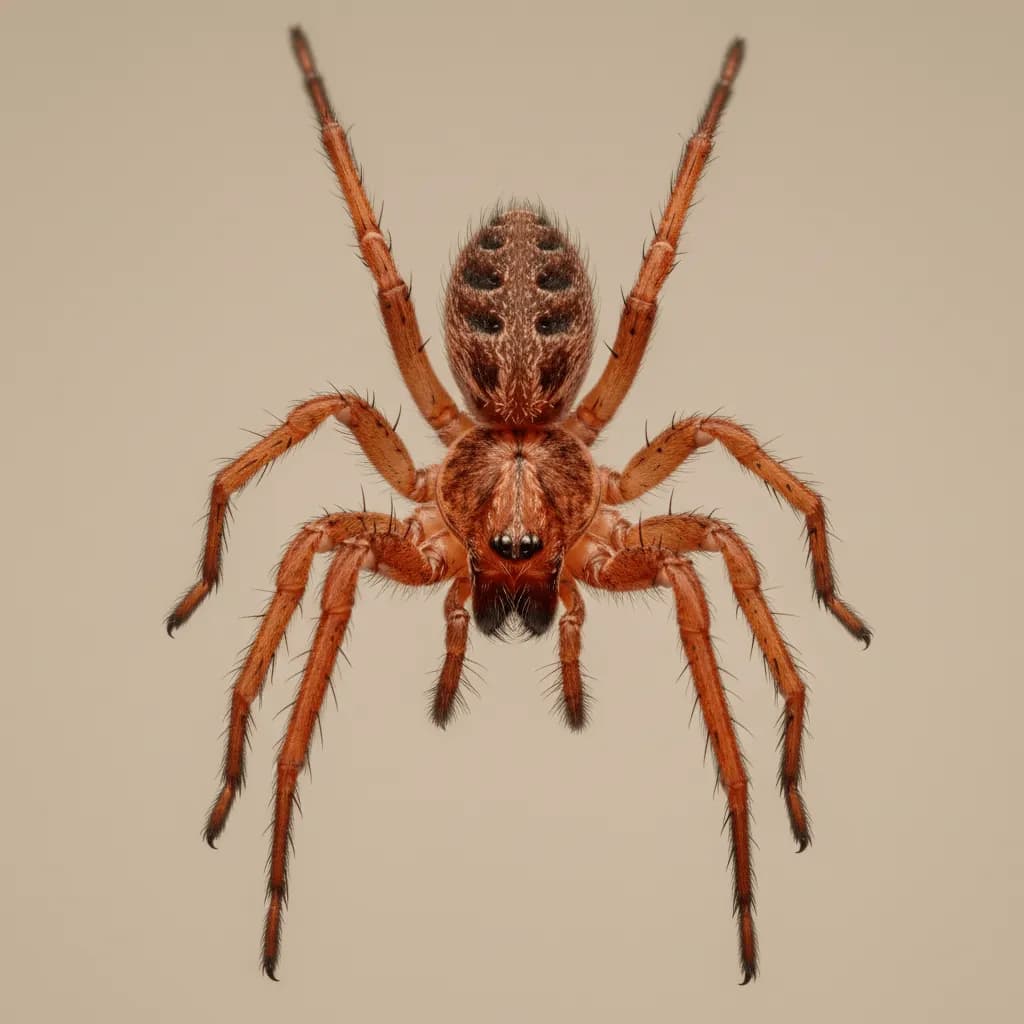
Sowbug Killer Spider
Dysdera crocata
Also known as: Woodlouse Hunter, Woodlouse Spider, Slater Spider
The Sowbug Killer is a specialized predator of pill bugs and sow bugs. Its oversized fangs are adapted to pierce the armored shells of isopods. It is commonly found in damp areas near its prey and occasionally wanders indoors. Despite its fearsome appearance, it is not dangerous to humans.
Identification
Size
10-15 mm body length
Color
Dark reddish-orange cephalothorax and legs; pale yellowish-gray abdomen
Key Trait
Distinctive two-tone coloring - dark red-orange front half, pale gray rear half; very large, forward-projecting fangs (chelicerae) adapted for piercing isopod shells.
Behavior & Habitat
Nocturnal hunter that actively pursues pill bugs and sow bugs. Hides under rocks, logs, and debris during the day. Does not build webs. Can deliver a bite if handled but is not aggressive toward people.
Habitat: Under rocks, logs, leaf litter, and in moist soil near isopod populations; basements and crawl spaces indoors.
Diet: Primarily pill bugs (Armadillidium spp.) and sow bugs (Porcellio spp.); occasionally other small invertebrates.
Signs of Infestation
- Distinctive red-and-gray spiders found under objects in moist areas
- Presence alongside pill bug and sow bug populations
- Occasional sightings in basements and ground-level rooms near exterior walls
Risks & Damage
Alarming appearance; can bite if handled but venom is not medically significant.
Prevention Tips
- 1.Reduce pill bug and sow bug populations around the foundation by removing harborage
- 2.Seal ground-level entry points and foundation cracks
- 3.Address moisture issues that attract both this spider and its isopod prey
Why DIY Treatment Often Falls Short
This spider is present because of its prey - pill bugs and sow bugs. Removing the spider without addressing the isopod population and moisture conditions means new spiders will move in.
Professional Treatment
Professionals address the root cause by reducing isopod populations through perimeter treatments, moisture remediation, and habitat modification, which naturally eliminates the sowbug killer population.
Related Pests
Frequently Asked Questions
Is the sowbug killer spider dangerous?
Why does it have such large fangs?
Does it mean I have a moisture problem?
Need Help With Sowbug killer spider?
If you're seeing signs of sowbug killer spider in or around your home, professional treatment is the fastest way to stop the problem. Lotus Pest Control offers free inspections to identify the issue and recommend the right solution.
At a Glance
- Category
- Occasional Invaders
- Scientific Name
- Dysdera crocata
- Size
- 10-15 mm body length
- Color
- Dark reddish-orange cephalothorax and legs; pale yellowish-gray abdomen
- Key Trait
- Distinctive two-tone coloring - dark red-orange front half, pale gray rear half; very large, forward-projecting fangs (chelicerae) adapted for piercing isopod shells.
- Regions
- Pacific Northwest, Northeast, West Coast, Mid Atlantic
- Threat Level
- Very Low
- Risk Types
- nuisance
- Seasonal Activity
- MarAprMayJunJulAugSepOctNovDecJanFebnonelowmoderatehighpeak