
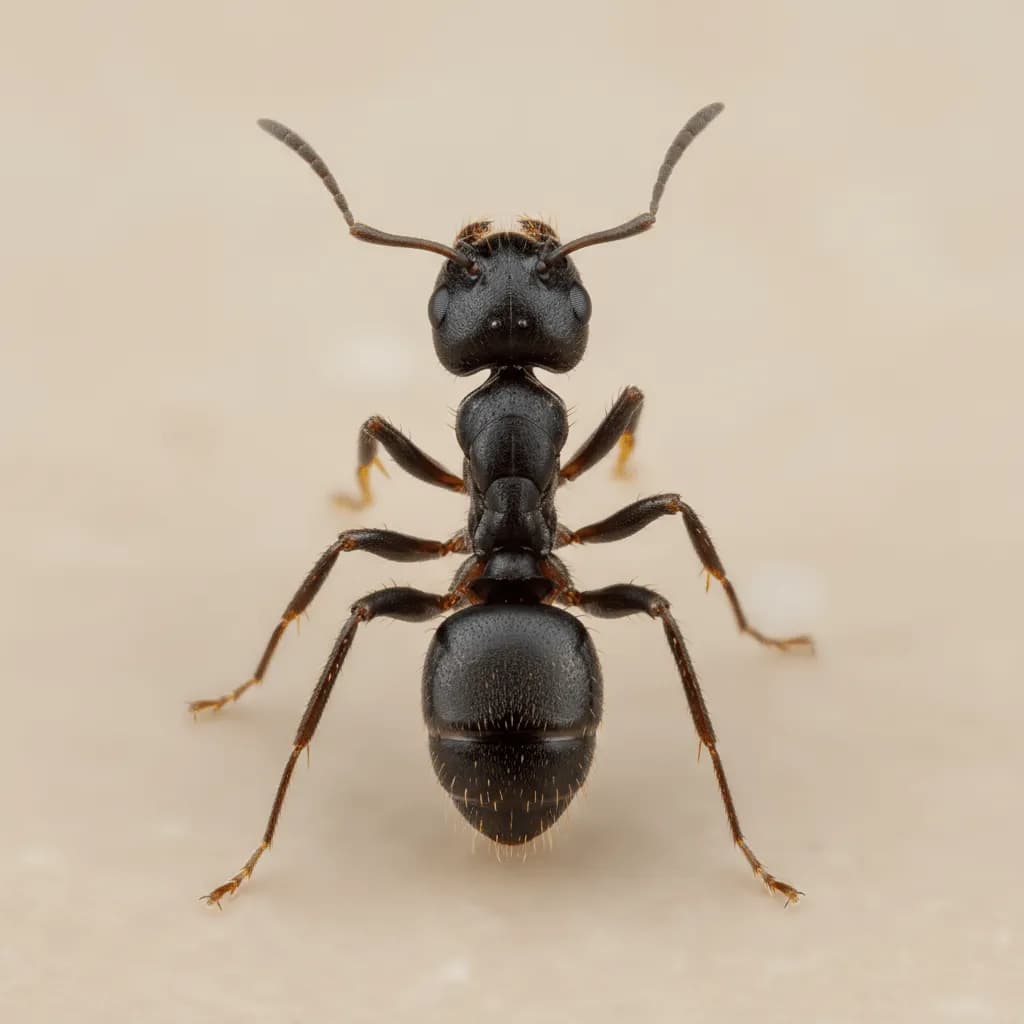
White-Footed Ant
Technomyrmex difficilis
Also known as: White Footed Ant
The White-Footed Ant is an invasive species that forms enormous colonies, sometimes containing millions of individuals. Originally from Southeast Asia, it has become a significant pest in the southeastern United States, particularly Florida. Its colonies can occupy multiple nesting sites connected by foraging trails.
Identification
Size
2.5-3 mm
Color
Dark brown to black body with pale yellowish-white tarsi (feet)
Key Trait
Distinctly pale feet contrasting with dark body; does not bite or sting; forms massive supercolonies with millions of workers.
Behavior & Habitat
Forms supercolonies with multiple queens and interconnected nesting sites. Workers do not share food via trophallaxis but instead lay unfertilized trophic eggs to feed larvae. Forages along well-defined trails on structures, trees, and shrubs.
Habitat: Nests in a variety of locations including dead wood, leaf litter, wall voids, attics, under roof shingles, tree canopies, and landscape mulch. Thrives in warm, humid environments.
Diet: Honeydew from sap-sucking insects such as aphids, mealybugs, and scale insects. Also feeds on sweet substances, nectar, and dead insects.
Signs of Infestation
- Long trailing lines of tiny dark ants on exterior walls, trees, or along roof edges
- Large numbers of ants near exterior lights at night
- Ants clustering around honeydew-producing insects on landscape plants
Risks & Damage
Massive colony sizes lead to overwhelming numbers indoors and outdoors, making them extremely difficult to control.
Prevention Tips
- 1.Trim tree branches and shrubs away from the structure to eliminate bridges
- 2.Treat honeydew-producing insects on landscape plants to remove the food source
- 3.Seal cracks and gaps around windows, doors, and utility penetrations
Why DIY Treatment Often Falls Short
Colony sizes of several million ants with multiple queens make baiting inefficient because workers feed larvae with trophic eggs rather than sharing bait via trophallaxis, reducing bait transfer through the colony.
Professional Treatment
Professionals use non-repellent liquid treatments around the perimeter combined with treatment of honeydew-producing insects on landscape plants. Long-term management requires ongoing monitoring due to the supercolony structure.
Related Pests
Frequently Asked Questions
Why are there so many of them?
Do white-footed ants bite or sting?
Why don't ant baits work well on them?
Need Help With White-footed ant?
If you're seeing signs of white-footed ant in or around your home, professional treatment is the fastest way to stop the problem. Lotus Pest Control offers free inspections to identify the issue and recommend the right solution.
At a Glance
- Category
- Ants
- Scientific Name
- Technomyrmex difficilis
- Size
- 2.5-3 mm
- Color
- Dark brown to black body with pale yellowish-white tarsi (feet)
- Key Trait
- Distinctly pale feet contrasting with dark body; does not bite or sting; forms massive supercolonies with millions of workers.
- Regions
- Southeast, Gulf Coast
- Threat Level
- Low
- Risk Types
- nuisance
- Seasonal Activity
- MarAprMayJunJulAugSepOctNovDecJanFebnonelowmoderatehighpeak