
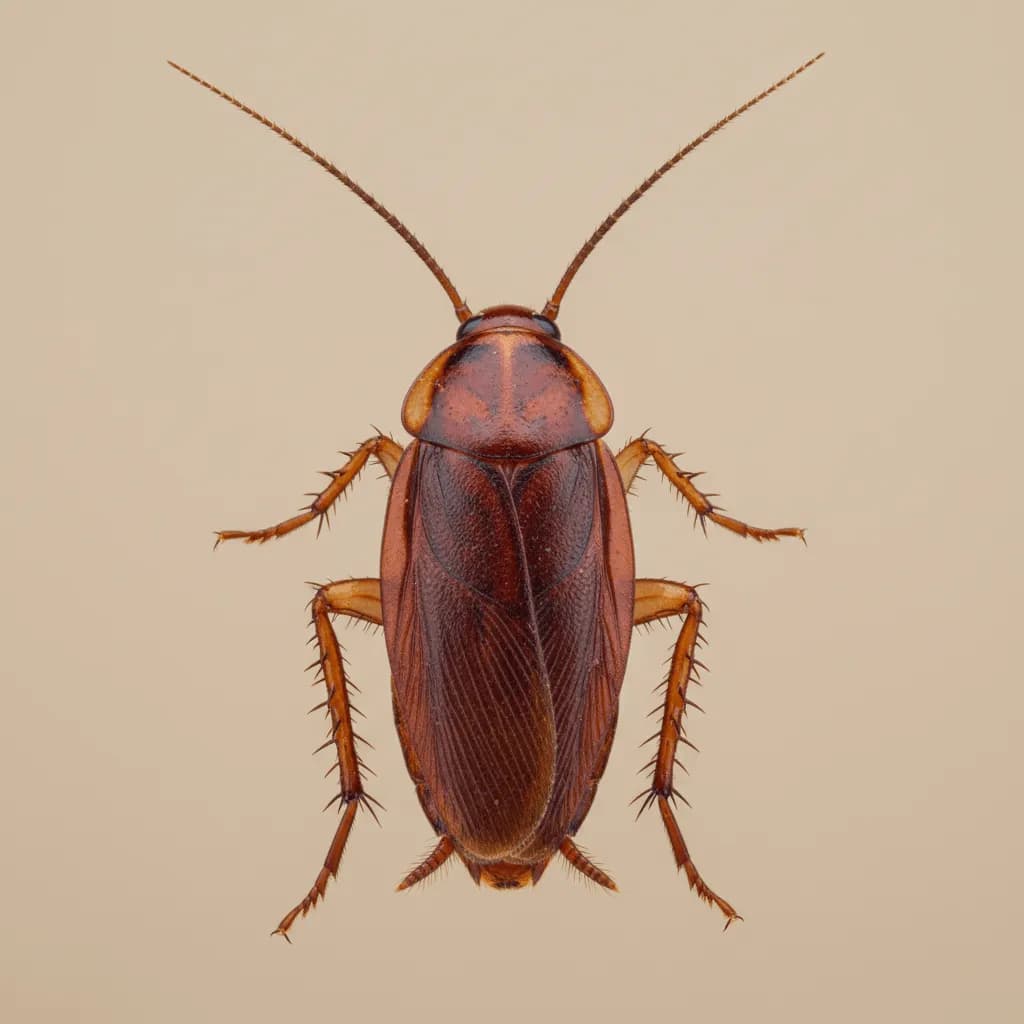
Turkestan Cockroach
Shelfordella lateralis
Also known as: Red Runner Cockroach, Rusty Red Cockroach
The Turkestan Cockroach is native to Central Asia and has spread rapidly across the southwestern United States since its introduction in the 1970s. It is displacing the Oriental Cockroach in many areas because it reproduces faster and tolerates drier conditions. Males are attracted to lights and fly readily, while females are ground-dwelling.
Identification
Size
25-30 mm
Color
Males are brownish-orange with long wings; females are dark brown to black with short wing pads
Key Trait
Strong sexual dimorphism - winged tan males and dark wingless females; rapidly displacing oriental cockroaches in the Southwest.
Behavior & Habitat
Males fly to lights at night; females stay near ground-level harborage. Colonies develop in utility vaults, meter boxes, and cracks in concrete. Reproduction rate is higher than the Oriental cockroach it replaces.
Habitat: Cracks in foundations, water meter boxes, irrigation valve boxes, block walls, and compost bins. Outdoors in mulch, leaf litter, and under concrete pads. Common around commercial and residential structures in arid climates.
Diet: Decaying organic matter, garbage, pet food, and plant material.
Signs of Infestation
- Tan male cockroaches flying to porch lights in summer
- Dark female cockroaches found in meter boxes and irrigation valve covers
- Roaches emerging from foundation cracks and block wall weep holes
Risks & Damage
Carries bacteria from outdoor harborage into homes, contaminating food surfaces.
Males flying to lights and females congregating in utility boxes alarm homeowners and utility workers.
Prevention Tips
- 1.Seal cracks in the foundation and block wall weep holes with mesh
- 2.Switch to amber exterior lighting
- 3.Treat water meter and irrigation valve boxes with residual insecticide
- 4.Reduce organic mulch and debris near the foundation
Why DIY Treatment Often Falls Short
Populations breed in hard-to-access areas like utility vaults and deep foundation cracks. Store-bought sprays may kill individuals on contact but fail to reach the breeding population or provide lasting protection.
Professional Treatment
Professionals treat utility boxes, foundation cracks, and block wall voids with residual insecticide and granular bait. Perimeter spray creates a barrier, and exclusion work seals common entry points. Quarterly treatments are recommended in heavily infested areas.
Related Pests
Frequently Asked Questions
Is the Turkestan cockroach replacing the Oriental cockroach?
Why do I find cockroaches in my water meter box?
How did Turkestan cockroaches get to the United States?
Need Help With Turkestan cockroach?
If you're seeing signs of turkestan cockroach in or around your home, professional treatment is the fastest way to stop the problem. Lotus Pest Control offers free inspections to identify the issue and recommend the right solution.
At a Glance
- Category
- Cockroaches
- Scientific Name
- Shelfordella lateralis
- Size
- 25-30 mm
- Color
- Males are brownish-orange with long wings; females are dark brown to black with short wing pads
- Key Trait
- Strong sexual dimorphism - winged tan males and dark wingless females; rapidly displacing oriental cockroaches in the Southwest.
- Regions
- Southwest, South Central
- Threat Level
- Low
- Risk Types
- healthnuisance
- Seasonal Activity
- MarAprMayJunJulAugSepOctNovDecJanFebnonelowmoderatehighpeak