
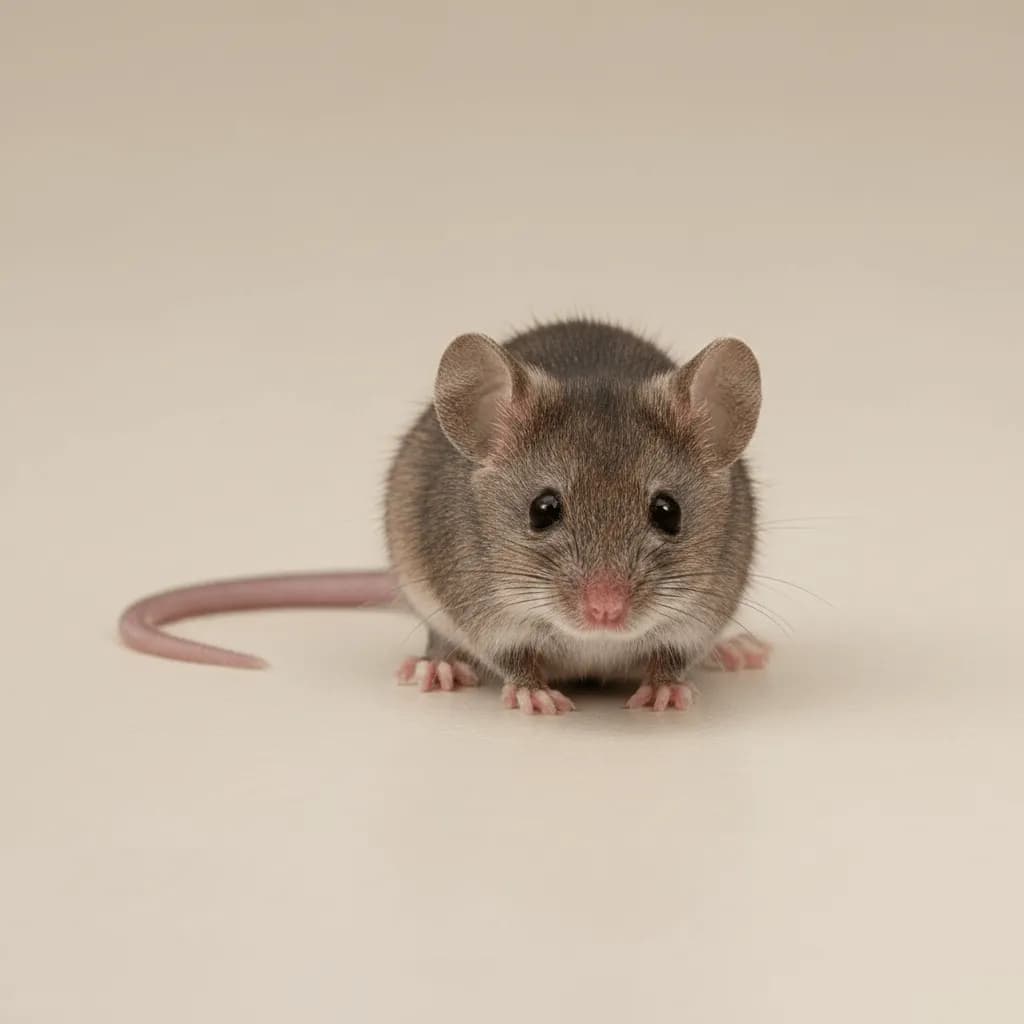
House Mouse
Mus musculus
Also known as: Common Mouse
The House Mouse is the most common commensal rodent in the world and the leading mammalian pest of homes and commercial buildings. Its small size allows it to enter structures through remarkably tiny openings. House mice contaminate far more food than they consume, producing 50-75 droppings per day scattered throughout their range.
Identification
Size
65-95 mm body length, plus 60-100 mm tail; 12-30 g
Color
Light brown to gray with a lighter underside
Key Trait
Small, slender body with large rounded ears, a pointed snout, and a nearly hairless tail about the same length as the body. Much smaller than rats, and can fit through gaps as small as 6 mm.
Behavior & Habitat
Curious and exploratory, unlike the neophobic rats. Investigates new objects and food sources quickly. Excellent climber that can scale rough vertical surfaces. Primarily nocturnal but may be active during the day in undisturbed areas. Establishes territories of 3-10 meters from the nest.
Habitat: Wall voids, cabinet voids, appliance interiors, storage boxes, attics, basements, and any sheltered void within a structure. Nests in soft materials like insulation, paper, and fabric.
Diet: Omnivorous with a preference for cereal grains and seeds. Can survive without free water by obtaining moisture from food. Consumes about 3 g of food per day and nibbles from many sources.
Signs of Infestation
- Small, rod-shaped droppings (3-6 mm) scattered in drawers, cabinets, and along walls
- Gnaw marks on food packaging, especially cereal boxes and stored grains
- Musky odor in enclosed spaces like cabinets, closets, and pantries
Risks & Damage
Contaminates stored food with droppings, urine, and hair. A single mouse produces 50-75 droppings per day.
Transmits salmonellosis, hantavirus, and lymphocytic choriomeningitis (LCM). Major source of indoor allergens.
Gnaws on electrical wiring, insulation, and building materials, creating fire hazards and reducing energy efficiency.
Prevention Tips
- 1.Seal all gaps larger than 6 mm with steel wool, copper mesh, or caulk
- 2.Store all food in airtight glass or metal containers and clean up crumbs promptly
- 3.Eliminate clutter and nesting material in storage areas, garages, and basements
Why DIY Treatment Often Falls Short
House mice reproduce rapidly, with one pair producing up to 60 offspring per year. Consumer snap traps catch a few mice but fail to address the underlying population. Small entry points (6 mm) are nearly impossible for homeowners to find without professional training.
Professional Treatment
Professionals perform detailed inspections using UV light to detect urine trails, identify all entry points, and assess population size. Treatment combines thorough exclusion sealing, interior snap trap programs, exterior bait stations, and sanitation recommendations. Follow-up monitoring verifies elimination.
Related Pests

Frequently Asked Questions
How small of a gap can a mouse fit through?
Will a cat solve my mouse problem?
Is one mouse a sign of infestation?
Need Help With House mouse?
If you're seeing signs of house mouse in or around your home, professional treatment is the fastest way to stop the problem. Lotus Pest Control offers free inspections to identify the issue and recommend the right solution.
At a Glance
- Category
- Rodents
- Scientific Name
- Mus musculus
- Size
- 65-95 mm body length, plus 60-100 mm tail; 12-30 g
- Color
- Light brown to gray with a lighter underside
- Key Trait
- Small, slender body with large rounded ears, a pointed snout, and a nearly hairless tail about the same length as the body. Much smaller than rats, and can fit through gaps as small as 6 mm.
- Regions
- Northeast, Mid Atlantic, Midwest, Southeast, West Coast, Pacific Northwest, Southwest, Great Plains
- Threat Level
- High
- Risk Types
- foodhealthstructural
- Seasonal Activity
- MarAprMayJunJulAugSepOctNovDecJanFebnonelowmoderatehighpeak