
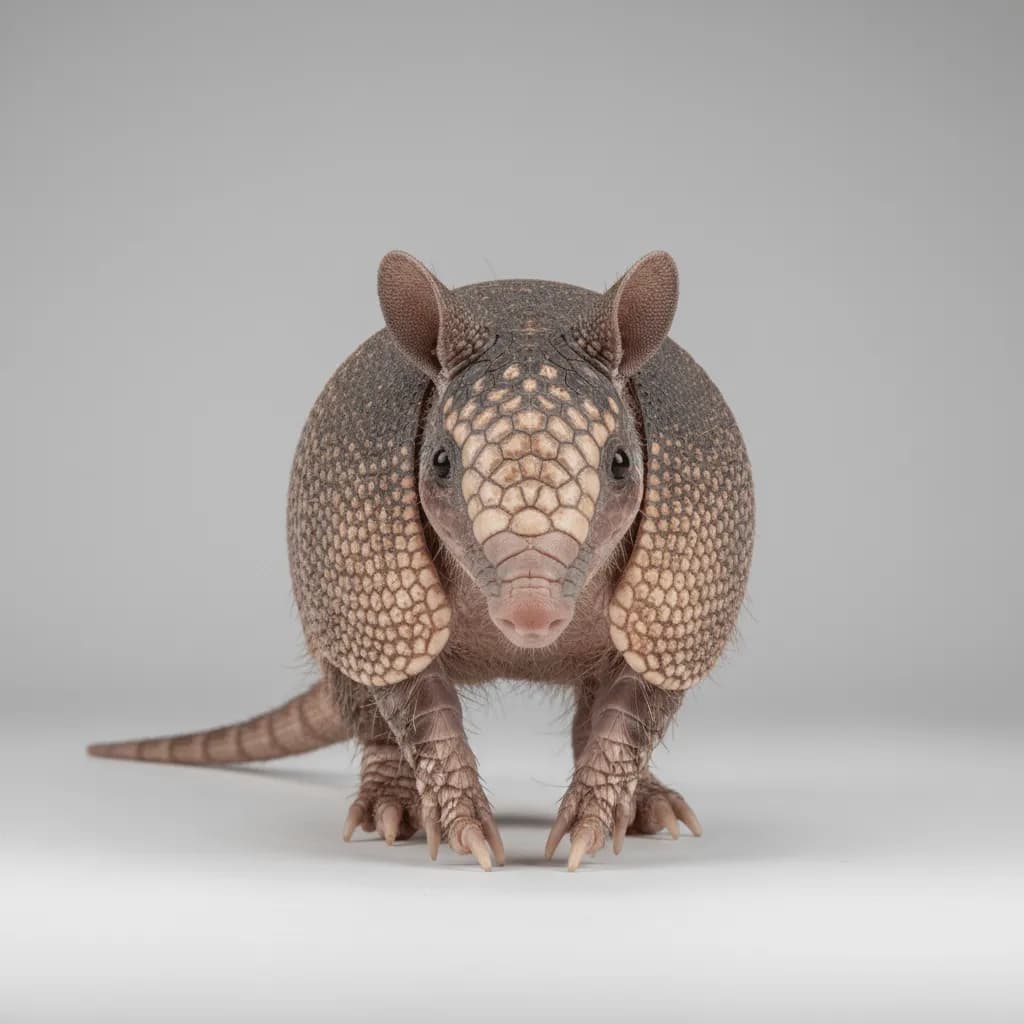
Nine-Banded Armadillo
Dasypus novemcinctus
Also known as: Common Armadillo, Long-Nosed Armadillo
The Nine-Banded Armadillo is expanding its range northward across the United States, driven by mild winters. It is a prolific digger that creates extensive burrow systems and leaves behind hundreds of small, conical holes in lawns and gardens while foraging for insects. Armadillos are the only animal other than humans known to naturally carry Mycobacterium leprae, the bacterium that causes leprosy.
Identification
Size
380-570 mm body; tail adds 240-370 mm; 2.5-6.5 kg weight
Color
Gray to dark-brown armored shell (carapace) with lighter yellowish underside; sparse, coarse hairs
Key Trait
Hard, bony shell (carapace) with nine movable bands across the midsection; long, pointed snout; large, shovel-like front claws; always gives birth to genetically identical quadruplets.
Behavior & Habitat
Primarily nocturnal. Digs small, conical foraging holes (5-10 cm deep) in lawns while rooting for insects. Creates large burrows (up to 5 meters long) under foundations, driveways, and retaining walls. Poor eyesight; relies heavily on smell. Jumps straight up when startled, which often causes road mortality.
Habitat: Brushy woodlands, forest edges, and suburban yards across the southern U.S. Burrows under foundations, sidewalks, driveways, and HVAC pads.
Diet: Insects and larvae (ants, beetles, grubs), earthworms, and small invertebrates obtained by digging. Occasionally eats berries, fungi, and small vertebrates.
Signs of Infestation
- Numerous small, conical holes (5-10 cm deep) scattered across the lawn
- Large burrow entrances (18-20 cm diameter) under foundations, porches, or driveways
- Disturbed mulch and uprooted plants in garden beds from nocturnal rooting
Risks & Damage
Creates hundreds of small foraging holes per night, destroying turf and garden beds.
Burrows under foundations, driveways, and HVAC pads, causing settling, cracking, and erosion.
The only non-human animal known to naturally carry Mycobacterium leprae, the bacterium causing leprosy. Transmission to humans is rare but documented.
Prevention Tips
- 1.Install buried fencing (at least 45 cm deep, angled outward) around high-value landscaping
- 2.Treat lawns for grubs to reduce the insect prey base
- 3.Remove brush piles and ground cover that provide daytime hiding spots
Why DIY Treatment Often Falls Short
Armadillos have powerful claws that defeat most lightweight barriers. They dig new foraging holes nightly across large areas, making spot treatment useless. Repellents (castor oil, mothballs) are ineffective against their strong digging instinct.
Professional Treatment
Professionals use targeted live trapping along established travel routes and burrow entrances. Permanent exclusion fencing with deep buried aprons protects critical areas. Grub treatment reduces the food source attracting armadillos.
Related Pests


Frequently Asked Questions
Can I get leprosy from an armadillo?
Why is the armadillo expanding northward?
Why do armadillos jump when startled?
Need Help With Nine-banded armadillo?
If you're seeing signs of nine-banded armadillo in or around your home, professional treatment is the fastest way to stop the problem. Lotus Pest Control offers free inspections to identify the issue and recommend the right solution.
At a Glance
- Category
- Wildlife
- Scientific Name
- Dasypus novemcinctus
- Size
- 380-570 mm body; tail adds 240-370 mm; 2.5-6.5 kg weight
- Color
- Gray to dark-brown armored shell (carapace) with lighter yellowish underside; sparse, coarse hairs
- Key Trait
- Hard, bony shell (carapace) with nine movable bands across the midsection; long, pointed snout; large, shovel-like front claws; always gives birth to genetically identical quadruplets.
- Regions
- Gulf Coast, Southeast, Southwest, Mid Atlantic, Midwest, Great Plains
- Threat Level
- Moderate
- Risk Types
- lawnstructuralhealth
- Seasonal Activity
- MarAprMayJunJulAugSepOctNovDecJanFebnonelowmoderatehighpeak