
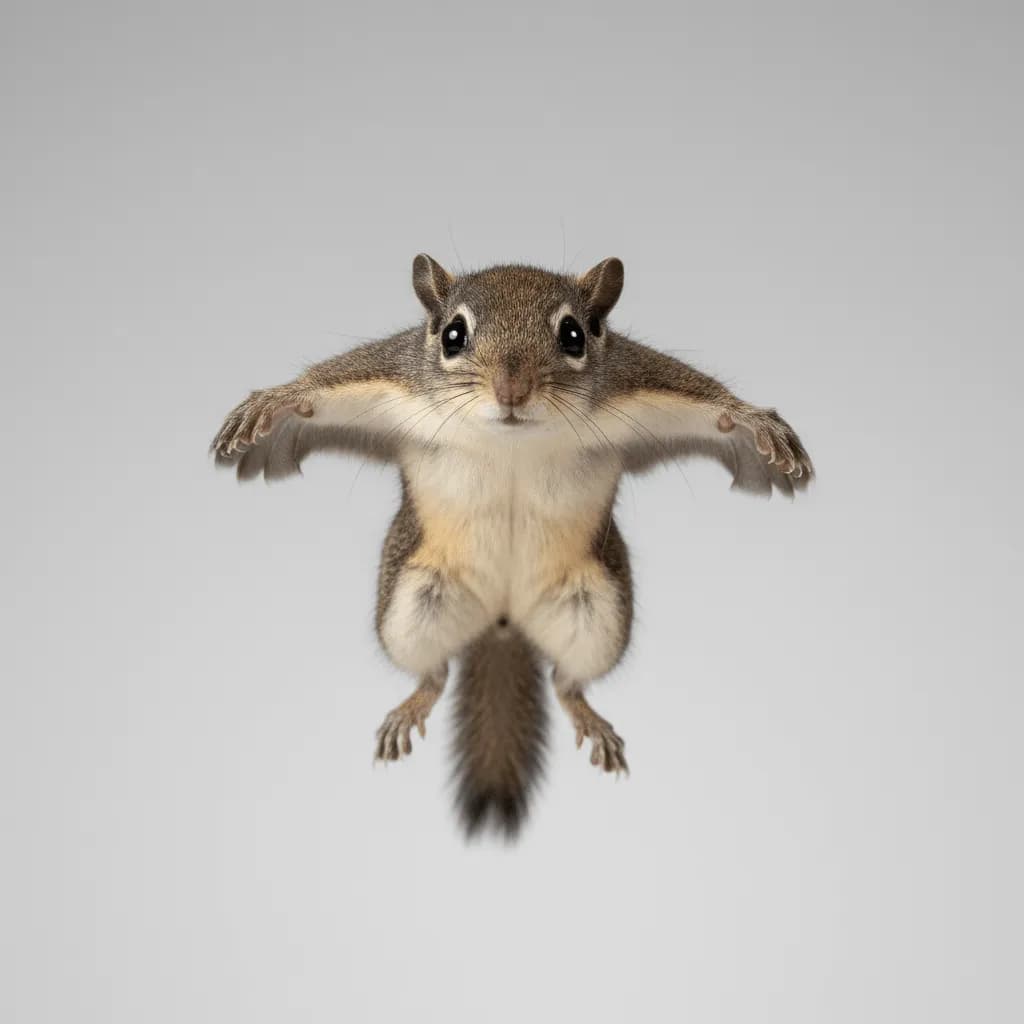
Flying Squirrel
Glaucomys volans
Also known as: Southern Flying Squirrel
The Southern Flying Squirrel is a nocturnal glider that frequently colonizes attics in large numbers. Because it is active at night, homeowners often hear scratching and scurrying sounds after dark and may initially mistake the noise for mice or rats. Colonies can grow to dozens of individuals in a single attic.
Identification
Size
120-140 mm body; tail adds 80-120 mm
Color
Soft gray-brown above with a creamy-white underside; large, dark eyes
Key Trait
Loose flap of skin (patagium) between front and hind legs enabling gliding; very large dark eyes adapted for nocturnal activity; much smaller than other tree squirrels.
Behavior & Habitat
Strictly nocturnal. Glides up to 45 meters between trees. Highly social - colonies of 10-20 or more commonly share a single den. Enters attics through remarkably small gaps (as little as 2 cm) and accumulates large volumes of cached food and droppings.
Habitat: Deciduous and mixed forests with abundant dead trees for den sites. Readily moves into attics, especially older homes near wooded areas.
Diet: Nuts, acorns, seeds, berries, fungi, lichens, insects, and bird eggs. Caches large quantities of food in attic spaces.
Signs of Infestation
- Persistent scratching and running sounds in walls or attic after dark
- Strong, musky odor from accumulated urine in attic insulation
- Small, smooth droppings similar in size to mouse droppings but slightly rounder
Risks & Damage
Large colonies compress and contaminate insulation, reducing its R-value and causing odor problems.
Droppings and urine harbor Salmonella and Leptospira. Flying squirrels are a primary reservoir for epidemic typhus (Rickettsia prowazekii) in the southeastern U.S.
Gnaw on wiring, though less aggressively than larger squirrel species.
Prevention Tips
- 1.Seal all exterior gaps larger than 2 cm with metal mesh or steel wool
- 2.Install chimney caps and cover attic vents with fine hardware cloth
- 3.Remove dead trees and snags close to the home that serve as launch points for gliding
Why DIY Treatment Often Falls Short
Flying squirrels are small enough to fit through gaps homeowners overlook, and colonies are large. Sealing one opening simply redirects them to another. Their nocturnal habits make it difficult to confirm all animals have been excluded.
Professional Treatment
Professionals conduct a thorough nighttime inspection to identify all entry points, then install one-way exclusion funnels. After the colony has fully vacated, every opening is sealed. Attic restoration addresses contaminated insulation.
Frequently Asked Questions
Can flying squirrels actually fly?
Why do I hear noises only at night?
Are flying squirrels dangerous?
Need Help With Flying squirrel?
If you're seeing signs of flying squirrel in or around your home, professional treatment is the fastest way to stop the problem. Lotus Pest Control offers free inspections to identify the issue and recommend the right solution.
At a Glance
- Category
- Wildlife
- Scientific Name
- Glaucomys volans
- Size
- 120-140 mm body; tail adds 80-120 mm
- Color
- Soft gray-brown above with a creamy-white underside; large, dark eyes
- Key Trait
- Loose flap of skin (patagium) between front and hind legs enabling gliding; very large dark eyes adapted for nocturnal activity; much smaller than other tree squirrels.
- Regions
- Southeast, Northeast, Mid Atlantic, Midwest, Gulf Coast
- Threat Level
- Moderate
- Risk Types
- structuralhealthelectrical
- Seasonal Activity
- MarAprMayJunJulAugSepOctNovDecJanFebnonelowmoderatehighpeak